Compare Structural Glass Systems: An Engineering and Design Guide
The architectural envelope has undergone a profound transformation. What was once viewed simply as an infill material designed to keep out the elements now functions as a primary, high-capacity, load-bearing component of the building envelope. Engineers are no longer limited to hanging lightweight glass curtains from steel skeletons. Compare Structural Glass Systems. Instead, structural glass systems carry dead loads, resist extreme lateral forces, and form entire structural members. This evolution requires a deep understanding of material science, where glass acts as an engineered composite rather than a brittle, monolithic sheet.
Selecting the right system requires rigorous analysis of physical constraints, loading histories, and environmental exposures. When designers attempt to compare structural glass variations without a firm grasp of their underlying mechanics, the results can be structurally and financially catastrophic. Glass does not exhibit plastic deformation; it responds elastically until the moment of rupture. This fundamental property makes the margin for design error exceptionally small. Minor oversights in edge finishing or load transfer can lead to sudden and complete failure at height.
To ensure long-term performance, design and construction teams must look past the visual rendering to analyze the physics of the system. This comprehensive reference document explores the engineering mechanics, system variations, and material options that govern high-performance envelopes. By exploring the physical behavior of various glass makeups, this guide provides a systematic methodology for specifying long-term authority assets that remain safe and functional over their entire design life.
Understanding “compare structural glass”
When professionals compare structural glass options across different projects, they must avoid treating glass as a single, uniform material. The term refers to a wide array of composite makeups, heat-treatment methods, and interlayer technologies. The most common pitfall in modern specification is the assumption that a makeup providing excellent performance in one environment will function identically in another. For example, an assembly that works well in a vertical, low-wind environment may fail if used in an overhead, point-supported skylight.
A deep understanding of structural properties requires analyzing how load is transferred through the thickness of the material. Monolithic annealed glass is highly sensitive to stress concentrations. When subjected to point loads or temperature differentials, it can fracture without warning. To make an accurate assessment, one must evaluate the residual stress profile induced by thermal tempering alongside the shear transfer capabilities of the chosen interlayer. The mechanical properties of the interlayer determine whether the system acts as a unified composite or as independent lites working in series.
Furthermore, the geometry of the connection points introduces another layer of complexity. Countersunk bolts and patch plates create localized stress concentrations that must be analyzed using advanced numerical methods. Failing to account for these localized forces can cause cracks to initiate around the fixings. Therefore, when comparing these materials, one must look at the entire assembly, including edge finishes, setting blocks, and structural silicone joints.
Deep Contextual Background: The Evolution of Load-Bearing Glazing
The development of structural glass systems began in earnest during the mid-twentieth century with the rise of the modern curtain wall. Early structural makeups were limited to punched window configurations set into thick masonry facades. As manufacturing techniques improved, the ability to produce large, flat lites of float glass allowed architects to maximize natural light and visual connection to the outdoors. However, these early configurations were structurally separate from the building’s primary gravity and lateral force-resisting systems.
The transition from supported glazing to structural glass occurred in the late 1970s and 1980s, pioneered by European engineers and architects who sought to eliminate opaque frames. This era saw the introduction of point-supported systems, where stainless steel patch plates and articulated bolts transferred wind loads directly to secondary support structures such as glass fins or tension trusses. The use of glass as a load-bearing material required new design standards, as engineers had to address the random nature of micro-cracks on the material’s surface.
Throughout the late twentieth and early twenty-first centuries, the development of high-strength structural interlayers and computer-aided engineering tools transformed the discipline. Laminated glass made it possible for an envelope to carry loads even after the fracture of an individual glass lite. Today, the rush toward taller, more slender facades has outpaced the understanding of these systems in many design offices, leading to repeated errors in edge preparation and thermal movement calculations.
Conceptual Frameworks and Design Models
To analyze structural performance, experienced engineers use several specific conceptual frameworks and mental models:
-
The Stress-Concentration Gradient Model: This framework models how loads transfer through holes, notches, and edges. It assumes that any discontinuity in the glass surface multiplies the local stress, requiring an evaluation of both the nominal and peak stresses within the lite.
-
The Thermal-Bridge Continuum: This model views the building envelope as a thermodynamic engine. It focuses on the difference in temperature between the center of the glass lite and the edge captured by the frame, calculating the resulting tensile stresses that can lead to thermal fracture.
-
The Redundancy/Fail-Safe Logic: This model analyzes system behavior after a failure occurs. It assesses whether the collapse of a single pane will lead to progressive failure or if the load can be safely transferred to adjacent components.
Technical Classifications and Key Variations
Understanding the differences between structural glass systems requires an analysis of their internal makeups and manufacturing histories. The following categories represent the primary systems used in modern facades and structural elements.
Classification of Structural Variations
| System Category | Makeup Description | Mechanical Behavior | Best Application | Trade-Offs & Vulnerabilities |
| Monolithic Fully Tempered | Single lite, rapidly cooled from 650C | High bending capacity; surface compression | Heavy frameless balustrades, fins | Low post-breakage capacity; NiS inclusion risk |
| Heat-Strengthened Laminated | Two or more lites joined with PVB or Ionoplast | Low residual stress; composite action after fracture | Vertical facades; overhead spans | Lower overall load capacity than tempered versions |
| Tempered Laminated | Two tempered lites joined with an interlayer | High impact resistance; residual post-breakage strength | High-traffic atriums, glass floors | Optical distortion, roller wave patterns |
| Ionoplast Laminated Composite | Multi-laminate makeup with rigid polymer core | High shear modulus; negligible creep under load | Glass fins, structural beams, overhead canopies | High material cost, higher fabrication weight |
| Insulating Structural Units | Double or triple IGUs with structural sealant | Thermal insulation combined with load-bearing perimeter | High-performance facade envelopes | High edge stresses; complex sealant detailing |
| Chemically Strengthened Glass | Ion-exchange bath treatment; thin, highly durable | High strength; low optical distortion | Specialized curved elements, interior partitions | High production cost; shallow depth of compression layer |
When you compare structural glass systems, the decision logic often starts with the post-breakage behavior of the system. For an overhead canopy, a designer must choose a laminated makeup using a stiff interlayer, such as an ionoplast polymer. If one lite breaks from impact, the interlayer prevents the fragments from detaching and falling onto the space below. Conversely, for an interior glass balustrade, a monolithic tempered lite may be appropriate because the edge loading is low and transparency is the primary design driver.
Detailed Real-World Scenarios and Decision Logic Compare Structural Glass Systems
Scenario A: The Supertall Spandrel Zone
A 60-story corporate headquarters located in a coastal metropolitan area experiences an unexpectedly high rate of glass breakage on its spandrel panels.
-
The Constraint: The spandrel panels are made of fully tempered, heat-absorbing monolithic glass placed directly in front of uninsulated backup walls.
-
Decision Point: Should the engineering team replace the broken panes with identical units, or redesign the spandrel zone to accommodate thermal movement?
-
Analysis of Options:
-
Option 1 (Identical Replacement): Replacing the panels without changes will result in continued breakage, as the root cause (high thermal stress due to shading) remains unaddressed.
-
Option 2 (Heat-Soaking and Edge Polishing): While heat-soaking reduces the risk of spontaneous breakage from nickel-sulfide inclusions, it does not resolve the thermal stress issue.
-
Option 3 (Redesign with Edge Clearance and Insulation): The team chooses to redesign the panels with polished edges and adequate expansion gaps, along with the addition of insulation behind the panel to reduce the temperature gradient.
-
-
Second-Order Effect: The new design requires an adjustment to the spandrel framing, slightly increasing the visual shadow line of the floor slabs.
Scenario B: Point-Supported Atrium Facade
A 40-foot-tall atrium wall uses a point-supported glass system with countersunk bolts. During a winter storm, several panes crack around the bolt holes.
-
The Constraint: The installation crew tightened the bolts using pneumatic tools to ensure a weather-tight fit, exceeding the design torque specifications.
-
Decision Point: Should the maintenance team retorque the bolts or replace the cracked lites?
-
Analysis of Options:
-
Option 1 (Retorque the Bolts): This option is unsafe, as micro-cracks have already formed around the bolt holes. Retorquing will accelerate catastrophic failure.
-
Option 2 (Replace the Damaged Lites): The team replaces the lites and implements a strict torque-control protocol using hand tools and calibrated wrenches with torque-limiting mechanisms.
-
-
Failure Mode Analysis: The failure was caused by the combination of localized bearing stress and the thermal contraction of the glass during cold weather.
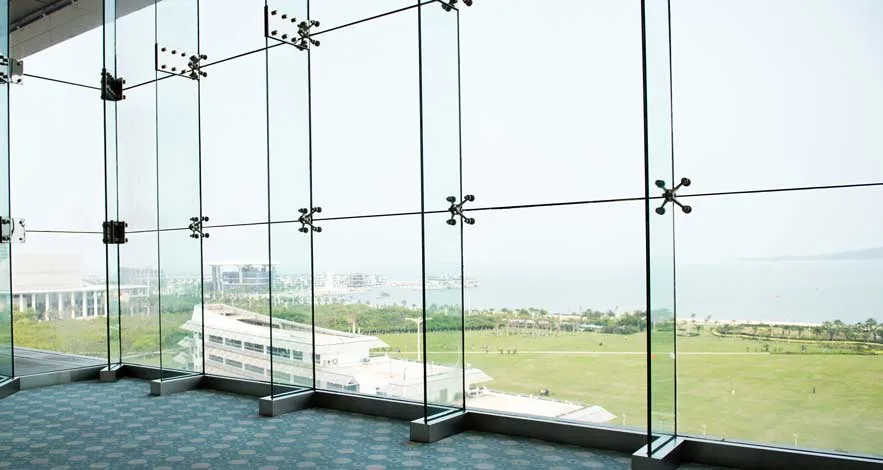
Scenario C: The Cable-Net Lobby Entrance
A high-end retail lobby features a 30-foot tall cable-net wall with point-supported fittings. After high wind events, the glass rattles and the silicone joints show signs of tearing.
-
The Constraint: The cable-net system is too flexible, allowing deflections of up to L/45, which exceeds the flexibility limits of the structural silicone bite.
-
Decision Point: Stiffen the cable-net structure or replace the glass with thicker, laminated lites.
-
Analysis of Options:
-
Option 1 (Thicker Glass): Thicker glass increases the load on the cables, which may cause the structure to deflect further.
-
Option 2 (Stiffen the Support Structure): The engineering team chooses to increase the pretension in the cables and install secondary dampers to limit deflection under wind loads.
-
-
Second-Order Effect: Increasing the pretension in the cables requires reinforcing the surrounding concrete columns and floor slabs to handle the higher reaction loads.
Scenario D: The Unitized Facade with Concealed Joints
A new residential tower uses a unitized curtain wall system with 4-sided structural silicone joints. During inspection, several units show signs of sealant peeling away from the aluminum frame.
-
The Constraint: The factory-applied structural silicone was applied when the aluminum was covered in a light film of manufacturing oil.
-
Decision Point: Strip and reglaze all units on-site, or remove the facade panels and reglaze them in the factory.
-
Analysis of Options:
-
Option 1 (On-Site Reglazing): It is difficult to achieve the required quality control for surface preparation and silicone curing on-site due to weather exposure.
-
Option 2 (Factory Reglazing): The team removes the units and returns them to the factory for proper solvent cleaning and reapplication of the structural silicone.
-
-
Compounding Risk: The delay in construction leads to exposure of the unfinished interior to rain, causing damage to the drywall and flooring.
Scenario E: The Cold-Bent Glass Canopy
A dramatic, sweeping glass canopy uses cold-bent, laminated glass lites to create a curved surface.
-
The Constraint: The glass is bent beyond its elastic limit during installation, placing permanent tensile stresses on the interlayer and the outer lite.
-
Decision Point: Maintain the design and accept the high risk of spontaneous breakage, or modify the radius of the canopy.
-
Analysis of Options:
-
Option 1 (Accept the Risk): The risk of glass falling on pedestrians is unacceptable from a life-safety perspective.
-
Option 2 (Modify the Geometry): The team modifies the canopy to use smaller, flat or slightly bent panels within the elastic limits of the glass.
-
-
Second-Order Effect: The change in geometry alters the architectural appearance of the canopy, requiring a redesign of the drainage and flashing details.
Planning, Cost, and Resource Dynamics
The financial architecture of a facade project is sensitive to design oversights. When common structural oversights are corrected during the construction phase, the costs can be many times higher than if the issue had been caught during the early engineering review.
Estimated Cost Variance of Remediation
| Phase of Discovery | Cost Factor (Multiplier) | Primary Cost Drivers |
| Concept / Design Phase | 1.0x | Additional FEA engineering, minor drafting changes |
| Fabrication Phase | 3.0x – 5.0x | Remanufacturing of lites, modified extrusion dies |
| Construction Phase | 10.0x – 20.0x | Crane rentals, site delays, rework of adjacent trades |
| Post-Occupancy Phase | 50.0x+ | Litigation, scaffolding, facade replacement, loss of rent |
Opportunity costs are often found in the logistics of the schedule. If an entire floor of the building is delayed because a custom-tempered panel must be remanufactured, the delay ripples through the timeline of all interior and exterior trades.
Tools, Strategies, and Technical Support Systems
To avoid these pitfalls, modern facade engineering relies on a suite of simulation and quality control tools:
-
Finite Element Analysis (FEA) Platforms: Software such as ANSYS or SAP2000 allows engineers to model the stress distribution within glass lites around holes and complex geometries.
-
Thermographic Analysis Tools: Software used to simulate the temperature gradient across the cross-section of an IGU to prevent thermal breakage.
-
Third-Party Laboratory Testing: Facilities such as the AAMA or CWCT test walls for air infiltration, water penetration, and dynamic structural loading.
-
Heat-Soak Ovens: Used to subject fully tempered glass to elevated temperatures, causing panes with nickel-sulfide inclusions to fail in the factory rather than on-site.
-
Torque Calibration Systems: Digital data loggers used on-site to verify the torque applied to every point-fixing bolt.
-
3D Laser Scanning: Used to survey the “as-built” concrete frame, allowing the fabrication dimensions to be adjusted before the glass arrives on-site.
Risk Landscape: Failure Modes and Compounding Risks
Failures in structural design are rarely the result of a single event; they are usually the result of compounding vulnerabilities.
For example, if a hole in the glass is drilled with a small defect on its inside surface, and the installer over-tightens the bolt, the two vulnerabilities work together. The high localized bearing stress from the bolt, acting on the stress concentration from the drilling defect, creates a situation where a normal gust of wind can cause the glass to fail.
The risk landscape is also complicated by the division of responsibilities. In many projects, the design of the glass and framing is “delegated” to the specialty subcontractor. If the design engineer does not communicate the specific edge clearance requirements to the installation crew, a high-quality glass pane can be ruined by poor field placement.
Governance, Maintenance, and Long-Term Adaptation
A structural glass facade requires a formal governance structure and a dedicated maintenance schedule to achieve its intended 30-to-50-year design life.
Layered Maintenance Checklist:
-
Quarterly Inspections: Inspect all gaskets and silicone seals for signs of cracking, peeling, or loss of adhesion.
-
Bi-Annual Cleaning: Wash the glass using deionized water and non-abrasive cleaners. Avoid strong alkaline or acidic solutions that can etch the surface or degrade the silicone.
-
Five-Year Structural Review: Perform a detailed inspection of all point-supported nodes and inspect the edge bite across a representative sample of the facade.
-
Trigger Event Response: Any seismic event or windstorm exceeding the design basis of the building requires a post-event survey of the entire facade, with special attention given to points of connection.
Measurement, Tracking, and Evaluation
Evaluating the success of a glass structure involves tracking both leading and lagging indicators:
-
Leading Indicators: Deflection readings during high wind events; analysis of manufacturing defects found during quality assurance audits at the factory.
-
Lagging Indicators: The frequency of glass breakages; the appearance of condensation or clouding within insulated glazing units.
-
Documentation Examples:
-
The Glass Log: A database tracking the tempering, laminating, and delivery of each lite.
-
Torque Calibration Reports: Digital records showing the torque values applied to each node during installation.
-
As-Built Surveys: 3D models comparing the real structure with the fabrication drawings to ensure clearances.
-
Common Misconceptions and Oversimplifications
-
Myth: Fully tempered glass is unbreakable.
-
Correction: Fully tempered glass is strong against bending, but it is highly sensitive to edge impacts and can shatter spontaneously due to internal inclusions like nickel sulfide.
-
-
Myth: All structural silicone is the same.
-
Correction: Structural silicone must be specified by chemical type and tested for compatibility with all adjacent materials.
-
-
Myth: Glass has no deflection limits.
-
Correction: Glass must be designed to limit deflection to maintain the integrity of seals and avoid edge pull-out.
-
-
Myth: Point-supported glass is frameless and simple.
-
Correction: Point-supported glass requires complex hardware and thicker glass lites to handle stress concentrations around the fixings.
-
-
Myth: Annealed glass is safe for modern facades.
-
Correction: Annealed glass breaks into large, sharp pieces and should not be used in high-altitude, high-wind, or high-impact areas.
-
-
Myth: Thermal stress is only an issue in cold climates.
-
Correction: Thermal stress is a problem whenever there is a temperature gradient across a panel, which occurs in both hot and cold climates depending on shading.
-
Ethical and Contextual Considerations
The use of structural glass facades has significant sustainability and ethical implications. Glass manufacturing is an energy-intensive process, and recycling complex, laminated, or coated glass is difficult. An ethical approach to design requires specifying products that maximize energy efficiency, reduce life-cycle operating costs, and utilize durable materials.
Furthermore, building design must consider the impact of transparency on bird populations. The reflection of trees and sky on glass facades causes millions of bird strikes each year. Modern building codes are increasingly requiring that envelopes include frit patterns, ultraviolet coatings, or external shading devices that make the glass visible to birds without obscuring the view from within.
Synthesis and Editorial Perspective
The design and construction of structural glass systems demand intellectual honesty, patience, and strict engineering discipline. The history of facade failures shows that most issues are not caused by the weakness of the material itself, but by the failure to correctly compare structural glass variations during the design and construction phases. Understanding the limits of the material allows engineers to create envelopes that are both transparent and safe.
The future of the building skin lies in intelligent design, where the interface between glass, frame, and structure is fully coordinated. As we move toward a carbon-neutral built environment, the measure of a successful facade will no longer be how invisible it appears, but how well it performs over the life of the building. The mastery of these details is what separates a short-term architectural trend from an enduring work of engineering.