Best Architectural Glazing Options: 2026 Specification Guide
The evolution of building envelopes over the past decade has elevated fenestration from a static, defensive barrier to an active, dynamic component of structural engineering. In contemporary architecture, the building skin mediates between internal comfort parameters and volatile exterior environments. Best Architectural Glazing Options. Large-format glazing, structural silicone innovations, and advanced metallic oxide coatings have redefined the mechanical and aesthetic possibilities of modern facades. For the architect, developer, or building scientist, navigating this domain requires a sophisticated understanding of thermodynamics, structural mechanics, and material science.
Glazing specifications must balance seemingly contradictory performance requirements. High visible light transmission must coexist with low solar heat gain; structural integrity against extreme wind loads must be achieved using ultra-thin, minimalist frame profiles; and acoustic dampening must be maintained across expansive, multi-story spans. best architectural glazing options. These complex demands have transformed the architectural glass supply chain. The contemporary marketplace requires an exhaustive assessment of glass compositions, gas fills, interlayers, and frame dynamics to ensure long-term physical and operational integrity.
This reference document deconstructs the physical, economic, and operational elements of modern fenestration. It explores the technical divergence between glass compositions, evaluates the systemic trade-offs of various systems, and provides an analytical framework for evaluating performance under real-world conditions. By moving beyond basic material descriptions, this analysis offers a comprehensive technical blueprint for specifying high-performance building skins.
Understanding “best architectural glazing options”
The terminology surrounding high-performance fenestration is often obscured by marketing nomenclature, making it difficult to isolate the objective properties of the building skin. To identify the best architectural glazing options for a specific project, one must move past general descriptions and evaluate physical parameters such as U-factor, Solar Heat Gain Coefficient (SHGC), Visible Transmittance ($T_{vis}$), and Shading Coefficient (SC). A common misunderstanding is the assumption that a highly insulated pane is universally appropriate across all elevations of a structure. In reality, an optimal design specification balances distinct facade orientations against varying sun exposure angles and local microclimates.
Oversimplification risks are particularly pronounced when evaluating smart or dynamic materials. Electrochromic or thermochromic glasses are frequently specified without proper analysis of the operational energy required to maintain the tint state, or the potential for premature degradation of embedded electronic components. The selection of a glazing system must account for the mechanical load of the glass itself, as well as the thermal bridging characteristics of the surrounding frame. Specifying an advanced triple-glazed unit within a thermally broken aluminum frame, for instance, can negate the thermal insulation properties of the glass if the frame-to-wall connection is improperly detailed.
Furthermore, the integration of bird-friendly design elements and acoustic interlayers adds further complexity to the design phase. A complete evaluation requires an understanding of the entire glass assembly. This includes the spacer technology, desiccant materials, primary and secondary sealants, and edge deletion protocols. Understanding the best architectural glazing options means viewing the glass unit not as a single layer of transparent material, but as an engineered multi-layer system designed to filter the internal and external environment.
Deep Contextual Background: The Evolution of the Building Skin
The architectural application of glass has undergone three major developmental phases over the past century.
-
The Early Modernist Curtain Wall (1930s–1960s): Characterized by single-pane, uninsulated assemblies. These early systems prioritized transparency and geometric purity, but they proved highly susceptible to extreme thermal transfer and condensation.
-
The Energy Crisis Response (1970s–1990s): This period spurred the development of double-glazed units and reflective metallic coatings. The focus shifted toward minimizing cooling loads through solar radiation control, though often at the expense of natural daylight.
-
The Dynamic High-Performance Era (2000s–Present): The modern era is defined by structural silicone glazing, vacuum-insulated glass, and dynamic coatings. These systems allow for expansive transparency while meeting rigorous net-zero energy building codes.
Conceptual Frameworks and Mental Models
When evaluating glazing systems, designers apply several mental models to quantify performance:
-
The Thermodynamic Balance Model: This model measures the relationship between conductive heat loss (U-factor) and radiant solar heat gain (SHGC). The ideal ratio changes depending on whether the building’s climate is cooling-dominated or heating-dominated.
-
The Acoustic Attenuation Index ($R_w$ or STC): This framework evaluates the ability of the glass assembly to reduce the transmission of airborne sound. It is particularly relevant for urban projects where heavy exterior noise pollution must be balanced with natural light.
-
The Structural Load Transfer Model: This model ensures that extreme wind loads are safely transferred from the large-format glass pane through the structural silicone joint and into the primary mullion system.
Key Categories and Material Variations
Achieving the correct envelope performance requires a careful review of the core categories of architectural glazing.
| Glazing Type | Thermal Insulation (U-value) | Sound Insulation (STC) | Solar Heat Gain Coefficient (SHGC) | Transmittance (Tvis) | Primary Structural Application |
| Double Glazing (Standard Low-E) | 0.28 – 0.33 | 31 – 34 dB | 0.35 – 0.55 | 0.70 – 0.78 | General Facades / Residential |
| Triple Glazing (Argon/Krypton) | 0.11 – 0.18 | 34 – 38 dB | 0.25 – 0.45 | 0.60 – 0.72 | Passive House / Cold Climates |
| Laminated Security/Acoustic | 0.35 – 0.42 | 37 – 42 dB | 0.32 – 0.40 | 0.65 – 0.74 | Overhead / Urban Sound Barriers |
| Electrochromic Smart Glass | 0.25 – 0.32 | 30 – 33 dB | 0.12 – 0.42 | 0.10 – 0.60 | High-Rise Commercial / Atriums |
| Vacuum-Insulated Glass (VIG) | 0.09 – 0.15 | 33 – 36 dB | 0.35 – 0.50 | 0.75 – 0.82 | Historic Retrofits / Ultrathin Frames |
| Structural Fritted/Low-Iron | 0.29 – 0.35 | 30 – 32 dB | 0.30 – 0.45 | 0.68 – 0.80 | Bird-Friendly / Structural Spandrels |
Realistic Decision Logic
When choosing a glazing system, the decision-making process should be mission-based. For a Passive House project in a cold climate, the Triple Glazing (Argon/Krypton) option is the logical choice, as its low U-factor prevents localized thermal discomfort near the window edge. Conversely, for a south-facing urban high-rise with high cooling loads, Electrochromic Smart Glass provides the dynamic control needed to prevent high cooling costs.
Detailed Real-World Scenarios Best Architectural Glazing Options
Scenario 1: The Coastal Residential Retrofit
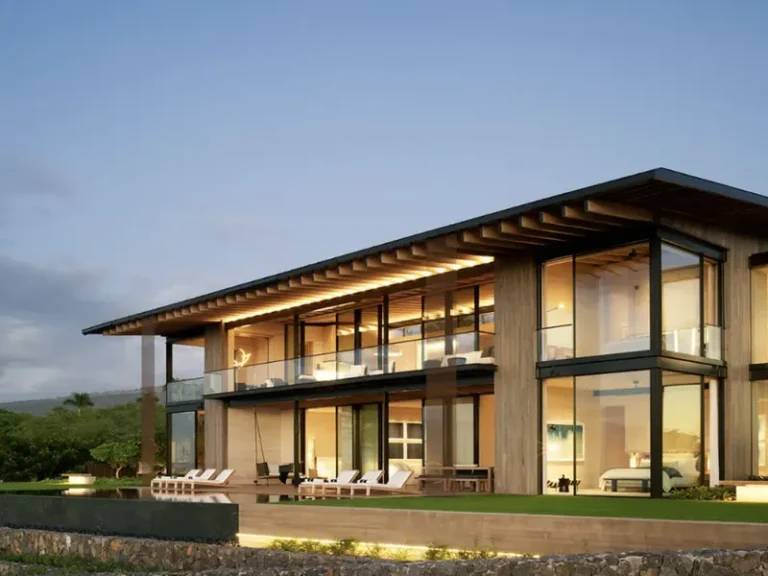
A coastal home requires large glass openings to maximize ocean views while withstanding high wind-borne debris loads and reducing salt-spray corrosion.
-
Constraints: High design wind loads (140+ mph) and corrosive, high-humidity environments.
-
Decision Point: The design must use laminated glass with an SGP (SentryGlas Plus) ionoplast interlayer rather than standard PVB, combined with marine-grade 316 stainless steel frame spacers.
-
Failure Mode: Specifying standard PVB interlayers in a humid, high-wind zone can lead to edge delamination and seal failure within 5 years.
-
Second-Order Effect: The use of thicker, heavier laminated glass requires structural framing calculations that alter the structural foundation and dead-load distribution.
Scenario 2: The Urban Mixed-Use Tower
An office complex is sited alongside an interstate transit corridor, necessitating strict acoustic and solar control.
-
Constraints: Extreme low-frequency traffic noise and high cooling demands.
-
Decision Point: The specification requires a double-glazed unit with an acoustic PVB interlayer and a low-E coating optimized for a low SHGC.
-
Failure Mode: Choosing a standard double-glazed unit to reduce costs will lead to unacceptable internal noise levels and require the HVAC system to work continuously during summer peaks.
Planning, Cost, and Resource Dynamics
The initial capital expenditure for high-performance architectural glass is often offset by long-term operational cost reductions.
| System Component | Direct Cost Range (USD/ft2) | Lead Time (Weeks) | Impact on Building Energy Use |
| Standard Low-E Insulated Units | $25 – $55 | 6 – 8 | Moderate Reduction |
| High-Performance Triple Glazing | $65 – $110 | 10 – 14 | Significant Reduction |
| Laminated Acoustic/Impact Glazing | $45 – $85 | 8 – 12 | Minimal Thermal Impact |
| Dynamic/Smart Glazing Assemblies | $180 – $350 | 16 – 24 | High Optimization Potential |
| Vacuum-Insulated Glass (VIG) | $120 – $225 | 12 – 18 | Exceptional Thermal Control |
The Cost of Frugality: Selecting a lower-cost glazing package can introduce thermal bridging and condensation, leading to mold growth and eventual envelope failure. The capital cost differential is often recovered through the downsizing of mechanical heating and cooling systems.
Tools, Strategies, and Support Systems
Specifying high-performance architectural glass requires a specialized technical toolkit:
-
THERM and WINDOW Software: Developed by the Lawrence Berkeley National Laboratory, these tools calculate two-dimensional heat transfer through complex frame and glass geometries.
-
LBNL Window 7 Database: Used to compare the thermal and optical properties of thousands of glazing and gas-fill configurations.
-
WUFI Modeling Software: Simulates transient heat and moisture transport through multi-layer assemblies to prevent internal condensation.
-
Structural Silicone Glazing (SSG) Standards: ASTM guidelines that govern the design of structural bite dimensions for glass-to-frame bonding.
-
Wind-Load Calculation Platforms: Software programs using ASCE 7 provisions to ensure glass thickness is adequate for local geography and building heights.
-
Glazier Certifications (NFRC/SGCC): Verifying product ratings for safety glazing and thermal transmittance.
Risk Landscape and Failure Modes
Advanced fenestration systems are subject to complex failure modes:
-
Thermal Stress Breakage: This occurs when a thick glass pane absorbs solar radiation unevenly, creating high tensile stresses along the cooler, shaded edges.
-
Seal Failure and Gas Loss: The degradation of the secondary edge seal allows ambient moisture to enter the cavity, causing internal fogging and corrosion of the low-E coatings.
-
Edge Delamination: Separation of the glass and interlayer in laminated units, often caused by prolonged exposure to standing water or UV radiation.
-
Deflection and Distortion: In large-format annealed or tempered glass, large spans can deflect under high wind loads, causing an optical phenomenon known as “pillow distortion.”
Governance, Maintenance, and Long-Term Adaptation
A high-performance facade requires a planned operational cycle to ensure its integrity:
-
Quarterly Visual Inspections: Checking perimeter sealants for signs of cracking or bubbling, which indicate chemical degradation.
-
Drainage Path Verification: Inspecting weep holes in the frame to ensure water from condensation or wind-driven rain does not pool against the edge seals.
-
Smart Glass System Diagnostics: Testing control wiring, sensors, and transformers in electrochromic configurations on an annual basis.
-
Envelope Commissioning (ASTM E2813): Conducting air and water infiltration testing every five years to maintain building performance certifications.
Measurement, Tracking, and Evaluation
To determine if a glazing specification is performing as intended, facility managers track several key performance indicators:
-
Leading Indicator: “Surface Temperature Uniformity.” Using infrared thermography to measure the temperature gradient across the glass surface during cold weather.
-
Lagging Indicator: “Monthly Energy Utilization Intensity (EUI).” An increase in this metric may indicate seal failure or degraded thermal performance of the fenestration.
-
Qualitative Signal: “Optical Clarity and Distortion.” Changes in optical performance indicate interlayer movement or stress on the system.
Common Misconceptions and Oversimplifications
-
“Triple glazing is always the best choice”: In warm, cooling-dominated climates, triple glazing can trap excessive heat, raising internal cooling costs.
-
“All Low-E coatings are the same”: Low-E coatings vary significantly in whether they favor high solar heat gain or low solar heat gain. Mis-specifying these coatings can compromise the building’s energy balance.
-
“Tempered glass is stronger than laminated glass”: While tempered glass resists impact better, it can shatter completely upon deep impact. Laminated glass remains intact, maintaining the barrier.
-
“Large-format glass requires thick frames”: Advanced high-strength SGP interlayers allow for minimal or frameless designs without sacrificing structural stability.
-
“Vacuum-insulated glass is only for windows”: VIG units are also used in retrofitting historical buildings where thick, heavy double-pane units cannot fit into original frames.
Ethical and Contextual Considerations
The use of highly reflective, clear glass facades has unintended environmental consequences, primarily bird collisions and high urban heat island effects.
To mitigate these impacts, modern building codes require the inclusion of ultraviolet patterns or ceramic frits in the glass assembly. Incorporating these patterns into the best architectural glazing options allows the building to remain transparent to human occupants while remaining visible to migratory birds.
Conclusion: The Trajectory of Architectural Glass
The architectural glazing sector is shifting toward greater integration of digital, mechanical, and structural functions within the facade. The building envelope is no longer a passive partition, but an active component that adapts to environmental variations. Specifying the correct glazing assembly requires balancing the physics of heat transfer with structural limits and environmental sustainability.
Designers who understand the long-term properties of the envelope can create buildings with lower energy consumption and long service lives. The future of architectural design lies in specifying dynamic, high-performance building skins that reduce reliance on mechanical conditioning systems.